Showing posts with label Books. Show all posts

Monday, May 16, 2011

Book Review: E is for Ethiopia

ORIGINALLY PUBLISHED ON THE WAYFARER

E is for Ethiopia is a great book. Using the alphabet as organization for an overview of interesting facts about Ethiopia the books it combines explanations and fabulous photographs of Ethiopia to share some of the wonder of the country with it's reader. I love this book because it is not a text book and is very interesting to my boys . They can see the culture of their birth in beautiful photos and words which helps them to connect to it. I also like that it is written by Ethiopians. They have the passion to pass along and I feel they do this well with this simple yet beautiful kids book.
Check it out on Amazon.

Wednesday, February 23, 2011

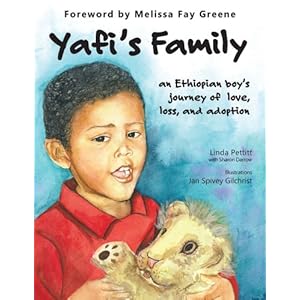
Book Review: Yafi's Family

ORIGINALLY POSTED ON THE WAYFARER

Yafi's Family is a great book. These are the things I love about this book:
1. the child is a boy
2. he is adopted as an older child
3. he is orphaned by death
4. he is Ethiopian
5. his parents retained his birth name
6. He has siblings in his adoptive home

I like these things because my boys can relate to each of these things very very well. It is a story about another boy, yet a story about themselves as well. The story is unique in that there are very few books about Ethiopian adoption, few books about older child adoption and even fewer about children who were orphaned by death rather than relinquished or abandoned. I would highly recommend this book for your home library. I think we will read this one over and over. As a note, I would suggest talking about feelings after you read this book and giving lots of affirmation. It triggered some sad feelings of loss the first time we read it for one of my sons. He likes this book, because it helps him feel like he is not alone in his loss. That is valuable.

Wednesday, February 2, 2011

Biographies/Autobiographies featuring Ethiopia

There is No Me Without You by Melissa Fay Greene

From Publishers Weekly: Not unlike the AIDS pandemic itself, the odyssey of Haregewoin Teferra, who took in AIDS orphans, began in small stages and grew to irrevocably transform her life from that of "a nice neighborhood lady" to a figure of fame, infamy and ultimate restoration. In telling her story, journalist Greene who had adopted two Ethiopian children before meeting Teferra, juggles political history, medical reportage and personal memoir. While succinctly interspersing a history of Ethiopia, lucidly tracing the history of AIDS from its early manifestation as "slim disease" in the late 1970s to its appearance as a bizarrely aggressive [form] of Kaposi's sarcoma in the early 1980s, and following the complex path of medication (a super highway in the West, a trail in Africa), Greene rescues Teferra from undeserved oblivion as well as rescuing her from undeserved obloquy (false accusations of child selling). As with her previous books (Praying for Sheetrock; The Temple Bombing; Last Man Out), Greene takes a very close look at what appears to be the fringe of an important social event and illuminates the entire subject. Ethiopia is home to "the second-highest concentration of AIDS orphans in the world"; even as some of the orphans find happy endings in American homes, Greene keeps the urgency of the greater crisis before us in this moving, impassioned narrative.


From Booklist: Haile's parents fled Ethiopia in 1976, two years after a brutal coup and the beatings that resulted in her father's paralysis. Her family relocated to central Minnesota, her father regained professional status as a scholar, and she eventually went to law school. The coup ended a centuries-old monarchy, replacing it with a dictatorship that was ousted by rebels in 1991. Twenty-five years after departing Ethiopia, Haile returns with her husband to explore the effect of the revolution and the upheaval that took away a sense of community. Although her family was reconstituted in the U.S., it was never the same. She gauges the change and measures the extent of her loss, even as she learns of her uncle's valiant efforts to maintain his engineering business and create jobs in a nation suffering from a faltering economy. Haile also sees firsthand remnants of timeless tradition and culture as well as a multicultural nation torn by ethnic divisions that threaten its sense of nationhood. This is a riveting and personal look at a nation still in turmoil.


From Amazon: In 1974 Hannah Pool was adopted from an orphanage in Eritrea and brought to England by her white adoptive father. She grew up unable to imagine what it must be like to look into the eyes of a blood relative until one day a letter arrived from a brother she never knew she had. Not knowing what to do with the letter, Hannah hid it away. But she was unable to forget it, and ten years later she finally decided to track down her surviving Eritrean family and embarked upon a journey that would take her far from the comfort zone of her metropolitan lifestye to confront the poverty and oppression of a life that could so easily have been her own.


From Publishers Weekly: "Hyenas are the most common, notorious predators in Ethiopia," notes Mezlekia, thus their power in local myth and as a metaphor for the forces that have torn Ethiopia apart in recent decades. This lyrical memoir of an Ethiopian childhood echoes both the myth and the violence of the hyena. In the first third of his literary debut, Mezlekia intersperses accounts of his mischievous, rebellious childhood with the magical tales told by his family to interpret various experiences: magic and spirits were part of everyday life for young Mezlekia. He also carefully delineates the customs of and relations between the Christian and Muslim communities in his hometown of Jijiga. (Mezlekia's mother, though a Christian, took her son to a Muslim medicine man to cleanse him following a series of boyish escapades.) But a third of the way through the text, the material world supplants the world of the spirit and innocence that governed Mezlekia's early childhoodAsocial and political upheaval ruled Ethiopian life in the late 1970s and '80s. At times, Mezlekia, who now lives in Canada, does not clearly describe the various factions that wrestled for power when he was a teenager and college student. But he treats the chaos and famine that enveloped his country with seriousness and styleA"The revolution was eating Ethiopian children at an alarming rate"Aand even while recounting famine and war, he never loses the wit that no doubt helped him to survive some of the worst humanity has to offer. (Jan.) Forecast: This lovely and terrible memoir will undoubtedly be well reviewed and thus reach readers interested not only in the fate of Africa but also in a lyrical account of a foreign childhood,


This is a Soul: The Mission of Rick Hodes by Marilyn Berger

From Amazon: Dr. Rick Hodes arrived in Africa more than two decades ago to help the victims of a famine, but he never expected to call this extremely poor continent his home. Twenty-eight years later, he is still there.

This Is a Soul tells the remarkable story of Rick Hodes's journey from suburban America to Mother Teresa's clinic in Addis Ababa, Ethiopia. As a boy, Rick was devoted to helping those in need, and eventually he determined that becoming a doctor would allow him to do the most good. When he heard about famine in Africa, that's where he went, and when genocide convulsed Rwanda, he went into the refugee camps to minister to the victims. When he was told that Ethiopia was allowing its Jews to emigrate to Israel, he went to help. While there, he was drawn to Mother Teresa's mission in Addis Ababa. It was there that Rick found his calling when he began caring for the sickest children in one of the world's poorest countries. But he did more than that—he began taking them into his home and officially adopted five of them.

This Is a Soul is also a book filled with great joy and triumph. When Rick's kids return from surgery or life-saving treatments, he is exultant. "Seeing these people after surgery is like going to heaven," he says.

Marilyn Berger went to Africa to write about Dr. Hodes, but while there, she became involved with the story. When she came upon a small, deformed, and malnourished boy begging on the street, she recognized immediately that he had the exact disease Rick could cure. She took him to Rick, who eventually arranged for the boy to have a complicated and risky surgery, which turned out to be incredibly successful. The boy's story—intertwined with Rick's, and Marilyn's as well—is unforgettable in its pathos and subtle humor.

This Is a Soul is not just a story of the savior and the saved, it is a celebration of love and wisdom, and an exploration of how charity and devotion can actually change lives in an overcrowded, unjust, and often harsh world.


If you've read any of these books, please feel free to review them in the comments. Know of other bios or autobiographies featuring Ethiopia? Please leave a comment too!

Wednesday, January 26, 2011

Novels that take place in Ethiopia

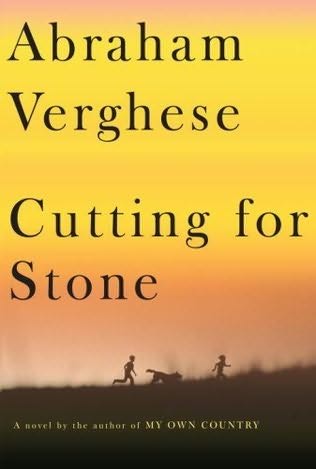
Cutting for Stone by Abraham Verghese
From Publishers Weekly: Lauded for his sensitive memoir (My Own Country) about his time as a doctor in eastern Tennessee at the onset of the AIDS epidemic in the 80s, Verghese turns his formidable talents to fiction, mining his own life and experiences in a magnificent, sweeping novel that moves from India to Ethiopia to an inner-city hospital in New York City over decades and generations. Sister Mary Joseph Praise, a devout young nun, leaves the south Indian state of Kerala in 1947 for a missionary post in Yemen. During the arduous sea voyage, she saves the life of an English doctor bound for Ethiopia, Thomas Stone, who becomes a key player in her destiny when they meet up again at Missing Hospital in Addis Ababa. Seven years later, Sister Praise dies birthing twin boys: Shiva and Marion, the latter narrating his own and his brothers long, dramatic, biblical story set against the backdrop of political turmoil in Ethiopia, the life of the hospital compound in which they grow up and the love story of their adopted parents, both doctors at Missing. The boys become doctors as well and Vergheses weaving of the practice of medicine into the narrative is fascinating even as the story bobs and weaves with the power and coincidences of the best 19th-century novel.


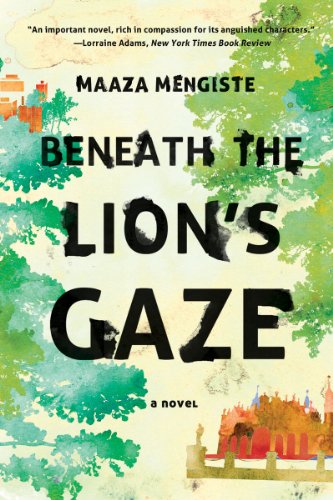
Beneath the Lion's Gaze by Maaza Mengiste
From Publishers Weekly: Ethiopia's 1974 revolution tears a family in half in this striking debut. Drought, famine and mutiny in the military are stretching Emperor Haile Selassie's regime to the breaking point, and when it finally tears, Hailu, a skilled and respected doctor in Addis Ababa, must find a way to shepherd his extended family through the ensuing violence. His task is made no easier by the fact that his son Dawit's fiery youthful convictions place him at odds with his more circumspect older brother, Yonas, a university professor with a wife and child. But when soldiers request Hailu to treat a gruesomely tortured political prisoner, he makes a fateful choice that puts his family in the military junta's crosshairs. Mengiste is as adept at crafting emotionally delicate moments as she is deft at portraying the tense and grim historical material, while her judicious sprinkling of lyricism imbues this novel with a vivid atmosphere that is distinct without becoming overpowering. That the novel subjects the reader to the same feelings of hopelessness and despair that its characters grapple with is a grand testament to Mengiste's talent.


Sweetness in the Belly by Camilla Gibb
From Booklist: Lilly, a young white Muslim woman, is eight when her British parents are killed in Morocco, and she is placed in the care of a Muslim disciple, who fills her days with the teachings of Islam. She later moves to Ethiopia, where she becomes a nurse, teaches local girls to recite the Qur'an, and falls in love with Aziz, a medical student who supports the overthrow of Emperor Haile Selassie. Lilly's tenuous ties to the monarchy force her to flee to London when Selassie is deposed, in 1974; there she immerses herself in a refugee support group and waits to be reunited with Aziz. Gibb adroitly flips back and forth between prerevolution Ethiopia, where Lilly, though a foreigner, is admired for her knowledge of Muslim teachings, and London in the 1990s, where she feels stronger ties to Muslim refugees than to the British, who feel increasingly threatened by the refugees' presence. Gibbs' novel is a gripping and provocative addition to the post-9/11 genre of fiction exploring the many facets of Islam

If you've read any of these books, please feel free to review them in the comments. Know of other novels featuring Ethiopia? Please leave a comment too!

Monday, July 26, 2010

Tips for your Ethiopia trip...

ORIGINALLY POSTED BY HEATHER ON TEN MORE TOES

I just finished a really good travellers guide about Ethiopia and recommend it to anybody going to pick up their sweethearts. It is from the Culture Smart series and written by Sarah Howard.


Here are just a few of the interesting facts and travel tips I have learned from this book:

* Half the estimated population of Ethiopia (77 million) is under 20 years old.
* Remember to use the right hand to eat the injera and wot. The left is considered unclean.
* Time follows the traditional Middle Eastern twelve hour clock. The hours start at dawn (6:00). So, twelve noon is 6:00 in Ethiopian time. Be sure to ask which time somebody is giving you for your major appointment or court date.
* It is also a good idea to leave a small piece of food left on your plate. This shows the host that you are graciously full.
* Buna bet or "coffee house" is not what you think. These are usually bars that might also have hotels and prostitutes.
* Ethiopians often greet each other with an embrace, then a kiss on each cheek, and then again on the first cheek.
* Children will walk up to nine miles a day to attend school.
* Orthodox Ethiopians will fast on Wednesdays and Fridays and during the holidays. Fasting means only having one meal a day, usually after 3:00 and abstaining from dairy and meat products. As many as 250 days a year can be kept as fast days.
* Swimming pools at the Hilton and Ghion hotels are heated by natural springs.
* Public latrines are so public, they are called "en plein air." Bring your own toilet paper.

Monday, April 26, 2010

Young Children's Books about Ethiopia

Unfortunately, I don't yet have any first hand knowledge of the following five children's books about Ethiopia. So I'd really appreciate it if you left a comment with your thoughts if you have any of the books...thanks!
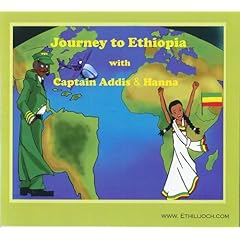
Journey to Ethiopia with Captain Addis and Hanna

Product description from the publisher: This is a wonderful children s book that takes young children on an exciting Journey to Ethiopia. A young girl who lives in America, Hanna, decides to write about Ethiopia for a school writing contest. Hanna is so excited when a special pilot, Captain Addis, arrives suddenly and takes her to Ethiopia! Hanna discovers her pride and love for Ethiopia as she travels to her families home country. She learns about the calendar system, New Year celebrations, visits the Simien Mountains and the Blue Nile, makes a friend with broken Amharic and sees the country very different than she imagined. Hanna and Captain Addis travel to exciting places all over Ethiopia. Join them on their journey!!!
Amazon product description: Abeba Goes to Bed is about Abeba, an Ethiopian girl. As time for bed approaches, Abeba says good night to those she loves and cares about in four different languages (English, Amharic, French and German). Containing only a few words and adorable illustrations, with a family tree and a favorite Ethiopian lullaby, this is a perfect read for all the little ones and offers parents a unique and beautiful way to ease their children towards bedtime.


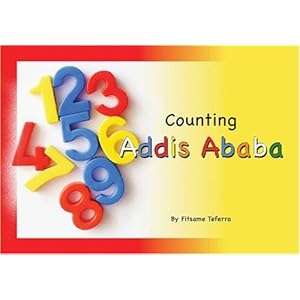
Counting Addis Ababa

Amazon product description: "Counting Addis Ababa," beautifully teaches young children the basics of counting from numbers one to ten in English, Amharic, and Oromiffa. Full page, full color illustrations accompany each counting lesson, depicting lovely scenes typical of life in Addis Ababa, with runners, women at market, young children, chickens, donkeys, and more. Children from all over will appreciate the bright colors, interesting scenes, and familiar faces of the characters in the book. A fun and colorful way to engage your child's early education.


Our First Amharic Words

Amazon product description: "Our First Amharic Words" has 75 Amharic words transliterated for easy pronunciation. Each word label includes the transliteration, English and Amharic language script called "Fidel".
Each word can also be heard on AmharicKids.com by native Amharic speakers.
Word categories include body parts, toys, animals, relationships, feelings, numbers, shapes and colors. The book is filled with beautiful photos of over 26 Ethiopian born children of ages ranging from infant to teenager.
Traditional Ethiopian items are used in the book and include a cultural explanation on the "What is it?" page. Also included is a map of Ethiopia and a fidel chart with pronunciation guide.
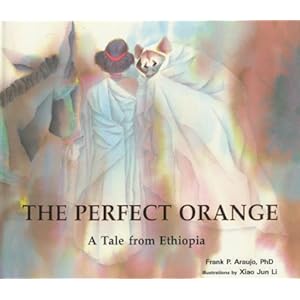


The Perfect Orange

From Publisher's Weekly: The author and illustrator of Nekane, the Lami & the Bear present the second volume in the Toucan Tales series of international folktales. Discovering a perfect orange in her Ethiopian mountain village, Tshai travels to the city to tender her prize to the great Nigus. When the girl passes the house of the Lord Hyena, the jeering animal scorns her silly gift. But the ruler himself is so moved that he tries to reward Tshai with riches. When she refuses, Nigus orders his Royal Chamberlain to follow her and give her a donkey whose saddle bags are filled with gold and jewels. The greedy hyena hastens to offer Nigus his bountiful lands and cattle. In return, the wise Nigus bestows on the crafty hyena "our most prized possession": one perfect orange. Li's watercolors contrast the cocoa-brown hues of the countryside and buildings with the stark white robes and brilliantly colored accessories of traditional Ethiopian dress; it's odd, however, that his Ethiopian characters have such pink skin. Araujo, who came across this tale while working in the Harare region of Ethiopia, spices up his retelling by incorporating Amharic words and phrases. Ages 3-12.

I do own and highly recommend Tsion's Life. Here is my review.

Again, I'd love to hear your thoughts on any of the above books. Thank you...

Monday, March 1, 2010

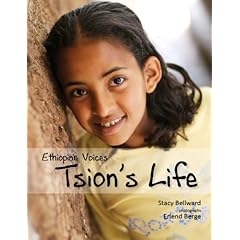
Tsion's Life

Ethiopia Voices: Tsion's Life by Stacy Bellward

From Rebecca Haile (Held at a Distance author): The striking photographs and carefully selected domestic scenes in Tsion's Life beautifully capture the day-to-day of one Addis Ababa family. This charming book is perfect for parents and educators seeking to give children an engaging and accurate glimpse into life in Ethiopia.

From Carey, an IAN waiting mama: The nearly full-page photographs are striking and really bring to life Tsion's world...her family, school, church, market, friends, etc. The book takes you through a typical day for Tsion like what she eats, how she cares for her brother and her family's sleeping arrangements. The book also introduces you to some basic Amharic words (though I wish there were phonetic keys with the words instead of a pronunciation guide in the back). I definitely recommend this book and would love it if the publishers would put out a few more showcasing kids who live in different areas of Ethiopia.

Monday, February 1, 2010

Attachment and Bonding

ORIGINALLY POSTED BY DAISYJ AT THE WAYFARER

Attachment is a real issue. It is as real for infants and toddlers as it is for older kids. There is so much information out there there is no reason to not arm yourself with information, tactics, strategies and ideas so that you have a warehouse of information when you get your child home at long last. You will know what to look for and what to do to help him or her and yourself. This is by no means an exhaustive list, nor even a really very good one. But, it is what I have found to be helpful for us and what I have posted on this blog. Happy bonding!

Here I will post some of my posts and links on attachment, as a matter of consolidation for those of you searching:
I am not going to advocate for any certain style of attachment therapy. I don't know anything about it. I am just listing resources that have been helpful for us. :)


From a general list on adoption resources:

Attachment:
Attachment Disorder Nancy Thomas Parenting Attachment.org Reactive Attachment Disorder
"Attaching in Adoption" by Deborah Gray
This is an important topic. Read all you can while you are waiting for your child referral and court date.

From a post on book recommendations:
Adoption and race for parents:
Toddler adoption the weaver's craft by Hopkins-Best
Taming the tiger while it is still a kitten by Nancy Thomas (the book is not particularly focused on Christians but I hear she is a Christian) I found this book to be a complimentary (to the Deborah Gray's book) list of attachment signs to look for and practical ideas for attachment. It is more of a booklet. I do not know anything about her particular theory's as this book does not address that.
Attaching in adoption by Deborah Grey
I'm chocolate you're vanilla by Marguerite A. Wright
Before You were mine (on making a Christian life book)*
Twenty Things Adopted Kids wish their parents knew by Sherrie Eldridge

Wednesday, January 27, 2010

Sensory Processing Disorder

Recommendations from IAN families -

Books for parents:

Books for kids:

From The Center for Adoption Medicine:
Sensory integration dysfunction (DSI), or as it is currently known, sensory processing disorder (SPD) is a complicated, somewhat controversial disorder of "sensory processing" - the ability to take in, filter, and respond appropriately to sensory input (touch, movement, vision, hearing, taste, and smell). Some children are felt to be "sensory-avoiding", or "sensory-defensive" - feeling bombarded by overly intense experiences of touch, lights, sound, and so on. Some children are "sensory-seeking", or "sensory under-responsive" - seeking intense stimulation, bashing and crashing around, and seeming less aware of pain and touch. Some children have trouble using sensory inputs to plan and perform gross and fine motor tasks ("dyspraxia", or motor planning disorder).

SPD is one of those diagnoses where definitive research on prevalence, validation of diagnostic tools, and effective therapy is lacking. It's especially hard to know when normal developmental, temperamental, and other individual differences in sensory responsiveness becomes a "disorder". It's underdiagnosed in many arenas, and overdiagnosed in others, just like any disorder where convenient but unvalidated checklists proliferate on the web, and where "cottage industries" marketing products and treatments are competing for your parental attention and money.

Having worked with a lot of post-institutionalized and alcohol-exposed children (two populations that are at higher risk for SPD), I am convinced that there are many such children for whom SPD is a real disorder - one that significantly impairs their function in home, social, and school environments. And I've seen children respond well to occupational therapy (OT) sensory interventions, especially functional approaches that integrate sensory work with the child's needs in motor skills and social interactions.

Even if your child's issues are more reflective of developmental immaturity or individual temperament than a definitive disorder, the sensory approaches can be fun, stimulating, and helpful with self-regulation and self-soothing. It's still hard to convince insurers and schools to fund such interventions, and depending on your situation, sensory-based therapy may not be the most pressing use of your time and money ... but here are some good resources on the topic. A lot of interventions are ones that you can do at home, and while there are scads of nifty products marketed for SPD, you can get a lot done with simple, cheap, or home-made tools and toys.

Sensory Processing Disorder Resources:

Monday, January 25, 2010

Brothers and Sisters in Adoption

Brothers and Sisters in Adoption by Arleta James

From Library Journal: Therapist James, who has many years of experience as an adoption professional, presents a superb, exhaustive handbook on adoption that fills a void in the literature. She focuses on issues surrounding families, with children who are flourishing, considering adopting children who have experienced complex trauma, including abuse, neglect, or abandonment. She delves deeply into the mental health issues of these children, which can be complicated by the existence of other adopted children. She concentrates on navigating the emotionally trying dynamics of the relationships among children who are thriving and those who are struggling, underscoring the needs of the typically developing children. Throughout the book, James includes stories of the adoptive families she has helped in her sessions. Numerous additional appendixes include a super preadoptive training model for typically developing children, an adoptive family safety contract, and an extensive listing of additional resources. This scholarly review of the adoptive literature combined with solid, pragmatic, and professional advice is a superb guide to a specialized topic. Required reading for all helping professionals working with child protective services or with adoptive families.

From Carey, an IAN waiting mama: I have not read this book yet but it is on my wishlist. Though it doesn't have many reviews on Amazon (6) it gets rave reviews.

If you've read this book, I would love if you gave it a brief (1 paragraph?) review. Please leave a comment so I can contact you. Thanks!

Tuesday, January 19, 2010

The Soul of a New Cuisine

The Soul of a New Cuisine: A Discovery of the Foods and Flavors of Africa by Marcus Samuelsson
From Publisher's Weekly: Born Ethiopian, raised Swedish, and now one of New York City's top chefs, Samuelsson (Aquavit: And the New Scandinavian Cuisine) has written an exotic yet accessible book that will hasten the coming of the African fusion cookery he envisions. His 204 recipes and 258 color photos are enriched with personal and political history; as in his many condiments and sauces, the balance is right. While he stresses the diversity and bounty of the second-largest continent, he repeatedly describes African cuisine as poor people's cooking, crafted with simple tools and necessarily emphasizing starches, vegetables and big flavors. Whether it's rosemary for Honey Bread or turmeric, ginger and cinnamon in his Vegetable Samosas, herbs and spices are always sauteed in oil or tossed in a hot dry pan, to intensify and mellow. He even proposes toasting the cinnamon for the whipped cream accompanying his Ethiopian Chocolate Rum Cake. The recipe for the cake is typical: the batter is prepared in a single bowl, mixed with a spoon, and bakes up moist and gingerbread-like, with great keeping properties. Toasting the cinnamon takes seconds and is impressive in the complexity it delivers.

From
Connie, an IAN mama about to travel: We received the most amazing cook book for Christmas. To even call it a cookbook is sort of an injustice. The recipes are amazing and remarkably simple, but the stories, photos and journalism about Africa are even more impressive. The author is Marcus Sameullson, an ET adoptee from Sweden and he now owns a number of successful ET restaurants in NYC. The book is called "The Soul of a New Cuisine". I haven't been able to put it down since we received it.

Thursday, January 14, 2010

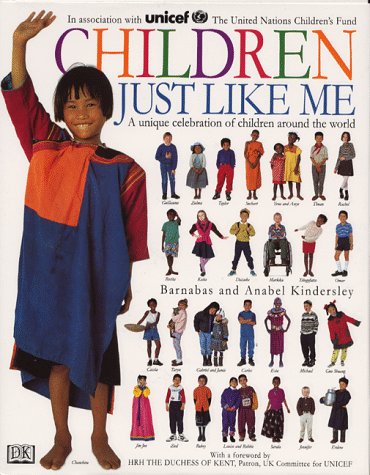
Children Just Like Me

Children Just Like Me by Barnabas and Anabel Kindersley

From School Library Journal: A delightful, attractive look at children from around the world. The authors spent two years meeting and photographing youngsters from every continent and more than 140 countries. The volume is divided by continent, which is introduced with photos of children, their names, and nationalities. Then a double-page spread features pictures of each child's food, eating utensils, housing, school, friends, and family. The text gives the young people a chance to comment on their favorite games, friends, and hopes for the future. The final section includes excerpts from the Kindersleys' travel diary. This book is factual, respectful, and insightful. It provides just the right balance of information and visual interest for the intended audience.

From Carey, an IAN waiting mama: I love, love, love this book! My (bio) sons (3 and 4 years old) like to look at the kids and have me read about their lives. It's opened up a lot of great discussions about how differently people live, yet we have so many similarities.

There is a spread dedicated to Tadesse, a nine year old boy in Ethiopia who lives in an orphanage because his father has died and his mother is not well enough to care for him and his siblings. (There is also a spread about a little girl in China who is an only child, with a mention of the government's concern of the growing population. Also, of possible interest to other adoptive parents, there are spreads on children in Russia, South Korea, India and Vietnam but not Guatemala.)

Every night my 4 year old asks to read about one of the children in the book. Since receiving this book over the holidays it has become part of our bedtime ritual...which I love.

Wednesday, January 6, 2010

Does Anybody Else Look LIke Me?

Does Anybody Else Look Like Me? A Parent's Guide to Raising Multiracial Children by Donna Jackson Nakazawa

From Publishers Weekly: The author, a freelance writer, is from a western European background, while her husband is Japanese American. Although Nakazawa initially hoped to raise her son and daughter to be "color blind," they couldn't ignore the many comments made by both adults and children concerning Christian and Claire's appearance. When Christian was a toddler he was asked if he spoke Chinese, and the author was assured that little Claire didn't "even look Asian." Nakazawa decided to develop strategies to ensure that her son and daughter would be proud of their heritage and confident about their multiracial identity. Finding no useful book on the subject, she decided to write her own. Based on personal experience and interviews conducted with 60 other multiracial families, Nakazawa has skillfully combined anecdotal research with a strong knowledge of childhood and educational development philosophy to provide this useful guide for raising multiracial children in a color- and race-conscious world. Nakazawa believes that, although most three-year-olds are not racially aware, it is important to deflect insensitive comments from strangers about appearance. As a child grows older, this early dialogue should deepen, so that children will feel safe and comfortable discussing their racial identity with parents and be able to bring up any racially charged experiences that have occurred at school or with friends. Included are suggestions for the special problems that may arise during adolescence.

From Carey, an IAN waiting mama: Though this book does address children with parents of different races, it also has lots of great info about internationally adopted children. I will definitely be rereading it once my daughter is home.